Pennsylvania Civil War Road Show
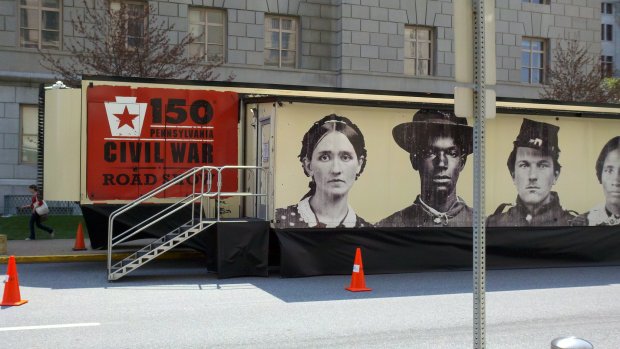
If you are planning to attend Anniversary Weekend at Antietam National Battlefield this year, one of the many fascinating displays and exhibits that you will see is the Pennsylvania Civil War Road Show.
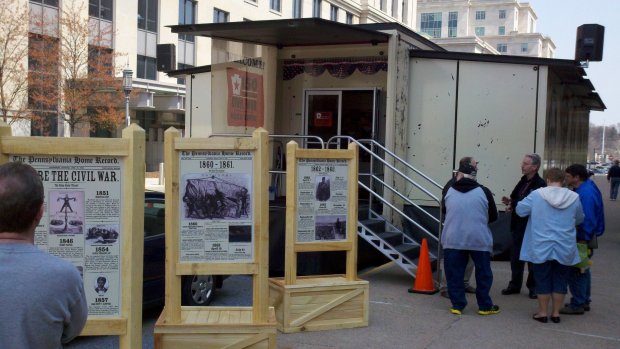
The PA Road Show is part of a statewide initiative sponsored by the Pennsylvania Historical & Museum Commission and the Pennsylvania Heritage Society to celebrate the story and role of Pennsylvania during the Civil War. In order to reach every corner of the state, a 53 foot, collapsible trailer was outfitted with special exhibit panels, interactive media, and audio in order to give visitors a solid overview of the Keystone state during the War.
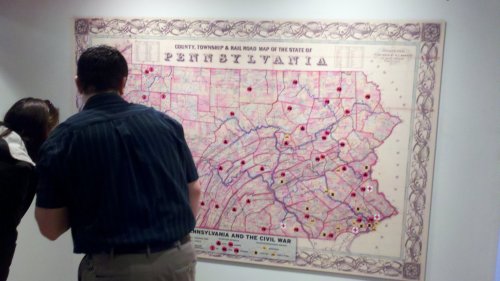
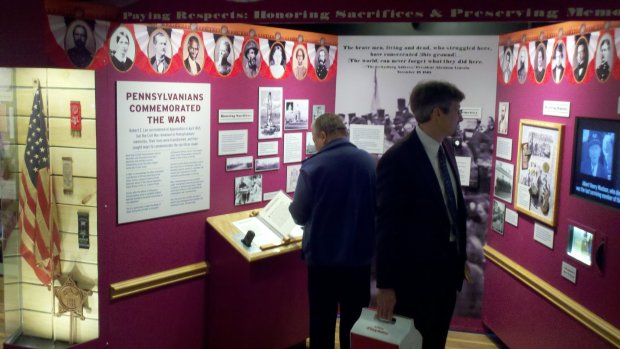
Most visitors might be surprised to learn that Pennsylvania in the Civil War was more than just Gettysburg (blasphemy!). In fact, one video tells the story of the disaster at the Allegheny Arsenal in Pittsburgh. Nearly 90 civilians, mostly women and children who were making ammunition for the Union war effort, were killed when a stray spark ignited thousands of pounds of black powder. The date of that disaster? September 17, 1862. That’s right. The same day as the Battle of Antietam, making the loss of soldier and civilian life that day truly the bloodiest day in American history.
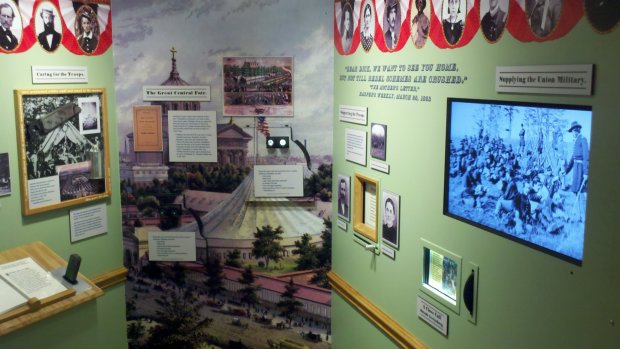
The Road Show also contains a video booth for anyone who wishes to record a story about a Civil War ancestor, an artifact, or their personal interest in the War. Visitors can also take “old time” pictures of themselves, and create a Civil War scrapbook as mementos of their experience.
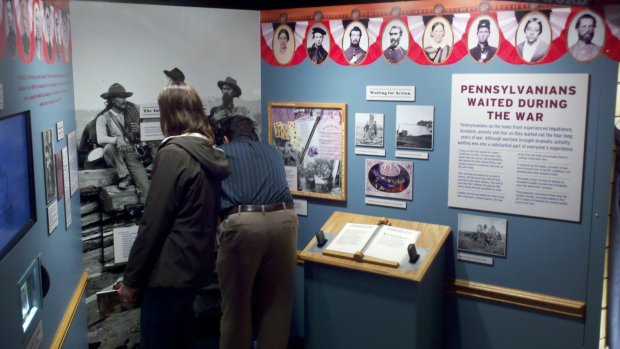
For nearly 2 years now, the Pennsylvania Civil War Road Show has crisscrossed the state, and visited all 67 counties. It’s trip to Antietam this month will be its first trip outside of the Keystone state. Originally planned to tour during the entire Sesquicentennial (2011-2015), this year will mark the last year for the traveling exhibit, as crucial funding has dried up. At the end of this year, the trailer will be taken apart and pieces of the exhibit will be on display in the State Museum in Harrisburg. So, Anniversary Weekend at Antietam may be your last opportunity to check it out! Look for the PA Civil War Road Show, as well Virginia’s traveling exhibit, in the parking area in front of the Antietam Visitor Center from Sept. 14 – 17.
Antietam 150th NPS Schedule
With a week to go before the kickoff of Antietam 150th Anniversary Weekend, we at Antietam Battlefield Guides hope you aren’t waiting until the last-minute to plan your Anniversary Weekend itinerary. Make sure you check out the schedule of events on Antietam National Battlefield’s website. Click here.
Take note of the call for names of Antietam casualties buried around the country:
Special Note:
As part of the commemoration of the 150th anniversary of the Battle of Antietam, a remembrance ceremony will take place at Antetiam National Cemetery on September 17th. This ceremony will feature a reading of the names of those soldiers killed or mortally wounded in the battle. The ceremony will begin at 3 p.m., and names will be read alphabetically by state, continuing throughout the afternoon. The public is encouraged to participate in the event by taking a turn reading names. We will read the names of those buried in Antietam National Cemetery, as well as in Washington Confederate Cemetery, Elmwood Cemetery, and Mt. Olivet Cemetery, but due to many circumstances some soldiers were buried in other locations.
To provide a more comprehensive list we are asking for your input. If you know of a soldier that was killed or mortally wounded at Antietam and is buried somewhere other than the cemeteries listed above, please send an email to e-mail us providing the soldier’s name, state, and any documentation you have for this information. We will add the name to our list. We appreciate your help as we honor and remember those who gave their lives at Antietam.
…..
We hope to see you out on the battlefield!
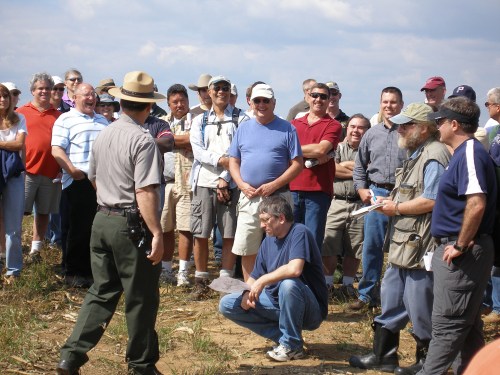
Antietam visitors enjoy a Ranger talk on Anniversary Weekend 2010.
photo by David R. Maher
Army of Virginia Withdrawal to Washington
Yesterday we marked the anniversary of the initial movements of the Union Army of the Potomac out of Washington in pursuit of Lee and the southern Army of Northern Virginia. However, just days earlier, the battered Union Army of Virginia, commanded by Gen. John Pope, limped back behind the defenses of the capital city after their defeat at 2nd Manassas. They would soon be merged into the newly re-organized Army of the Potomac, under the command of Gen. George McClellan. The following post first appeared on the blog of Antietam Battlefield Guide Randy Buchman (Enfilading Lines) on Sept. 2, 2012, and gives us a glimpse into this uncertain time for the North.
Withdrawal to Washington, September 2, 1862
Dispatches from Pope to Halleck revealed a commander in total loss and near breakdown. There was nothing to do but have the army fall back within Washington and reform. Doubleday wrote: General McDowell, with much feeling, directed me to lead off in this movement with my division. We were not molested, as Lee did not pursue, but rather started… for the invasion of Maryland via Leesburg. The news of the defeat of the army produced in Washington and throughout the country the lowest of all moments; for many, perhaps, the lowest of the War.

Artillery massed in Washington
By the afternoon of September 2nd, McClellan was dressed in his most splendid attire and riding out to meet the Army of Virginia units in retreat, and to take charge of the operation. When news that Little Mac was back became known to the troops, the word spread through the columns like a wave, with cheers and spontaneous celebration. Doubleday recorded his own meeting with McClellan: As I approached Falls Church with my division, I met General McClellan with a large retinue of staff officers—whose brilliant uniforms presented quite a contrast to our weather-stained equipments. He received us cordially and assured us we should be protected. The word jarred on my feelings as a soldier, for I felt that our force was even now superior to that of the enemy, and if he had done all that lay in his power to assist us, instead of doing his best to obstruct our operations, we would have entered as a conquering and not a defeated army. Immediately after this interview, my division was directed to take post at Upton’s Hill.
Pope was essentially finished as a Civil War commander. He was sent west to fight Indians. McDowell, the one Corps commander trusted by Pope, and who was by his side through the entire affair, was rumored to be treasonous at worst and incompetent at best, and sent to an insignificant post in California. The Union general faring the worst was Fitz John Porter. He would subsequently be convicted by court-marital of disobeying orders, and thereby removed from the army. His indiscreet pen had likely cost him as dearly as his derelictions of duty; though more than anything, he bore the brunt of anti-McClellan hostilities. Such attitudes were prevalent amongst Doubleday and his associates and staff officers. Noyes’ written account in 1863 characteristically gave most passionate expression to these sentiments: “But if there be in all this land men with souls so mean that in this crisis of their country’s destiny they could fail to throw their whole mind, body, and spirit into our last battle, could keep back their men lest haply they might reach the field in time to change the issue of the day, or obey their orders so tardily as utterly to foil the plans of the commanding general, then may God help them in that hour when they shall see in vision the accursed treason of their act, and its fearful consequences to the country and the world. Then shall the graves of the victims of their treachery send forth each its bloody witness, while all the tears and all the agony of the widows and orphans, who owe their grief to them, shall testify against them.”
 Welcome to the official site for the Antietam Battlefield Guide Association. The Antietam Guides are a group of historians dedicated to providing outstanding interpretive tours of the Antietam Battlefield, as well as other sites related to the Maryland Campaign of 1862. The Antietam Guides are booked through the Antietam National Battlefield Museum Store. This site offers a listing of our battlefield guides, as well as updates about our programs, what our guides are up to, and information about Antietam National Battlefield. We hope to see you at the park soon!
 Antietam Battlefield Guides