Dunkard Church Rising
the following post first appeared on the blog of Antietam Volunteer, and Antietam Battlefield Guide candidate Jim Buchanan (Walking the West Woods) on Nov. 27, 2009.
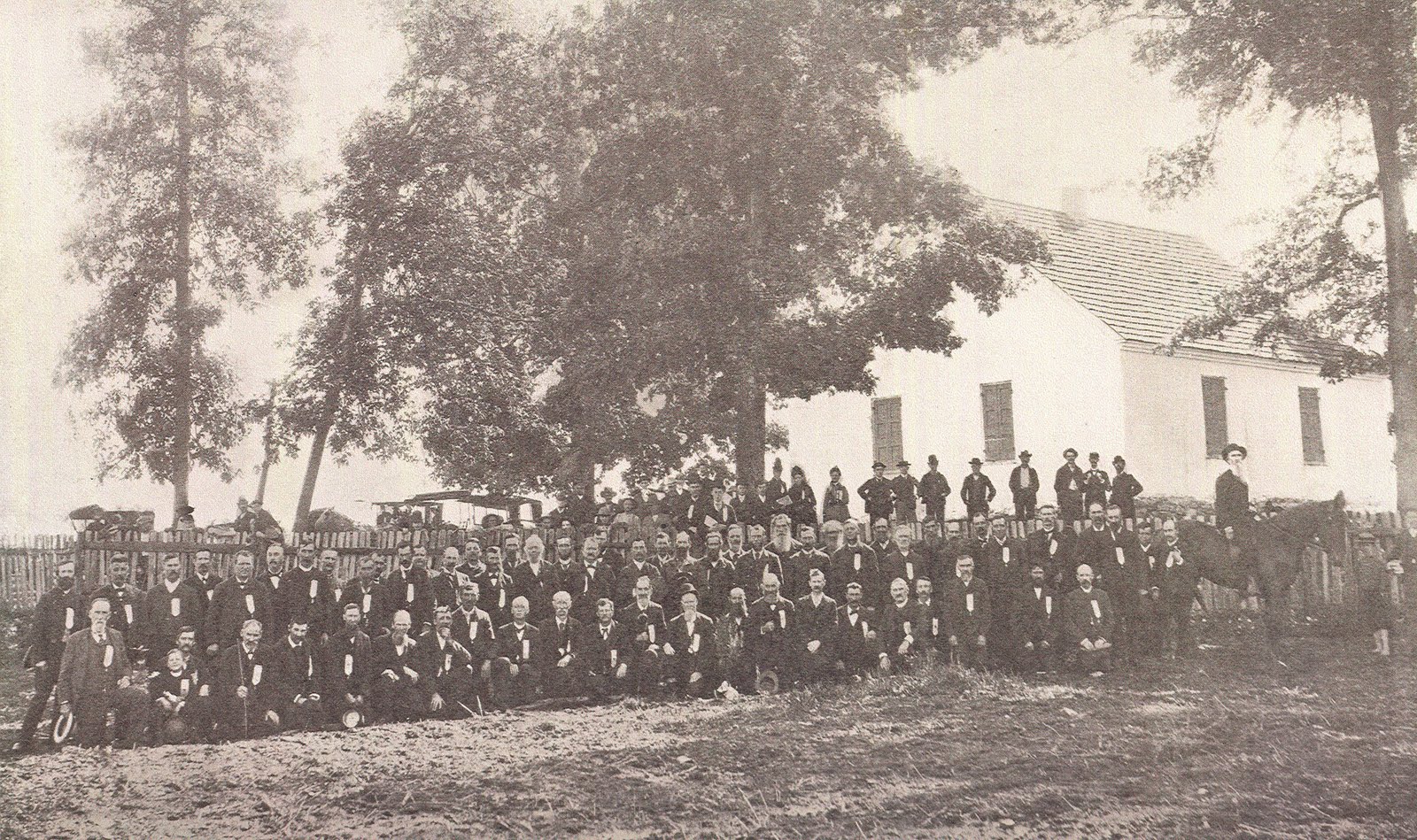
Reunion of the 125th Pennsylvania at the Dunker Church – Sept. 17, 1888
On September 17, 1906, Thomas J. Stewart, Adjutant General of Pennsylvania,
addressed those gathered for the dedication ceremonies for the Pennsylvania
Reserves monuments at the Antietam Battlefield..
“It is a glorious thing to be here,” he told the crowd, “As long as this nation lasts the story of Antietam will be told and when these monuments have crumbled to dust, Antietam’s story will live in the greatness of your example and in the glorious deeds done on this field. As long as the wind shall blow across yonder sunken road, they will sing the requiem for the mighty dead of this field; as long as the walls of the Dunkard Church shall stand they will seem to tell the story of the awful carnage of that place. …” (1) Less than fifteen years later the walls of the Dunkard Church no longer stood.
.
After the battle, the damaged church was restored and rededicated the following year. Services were resumed in it in 1864. Around 1916 the Dunkards moved to a new church location in Sharpsburg and the battlefield church was abandoned.
Over the next five years, neglect and souvenir hunters–who chipped away at the brick–left the church walls weakened.
.
A heavy storm on May 23, 1921, caused the walls and roof to collapse. (3)
The furniture and some building materials including bricks were salvaged by Elmer Boyer.(4)
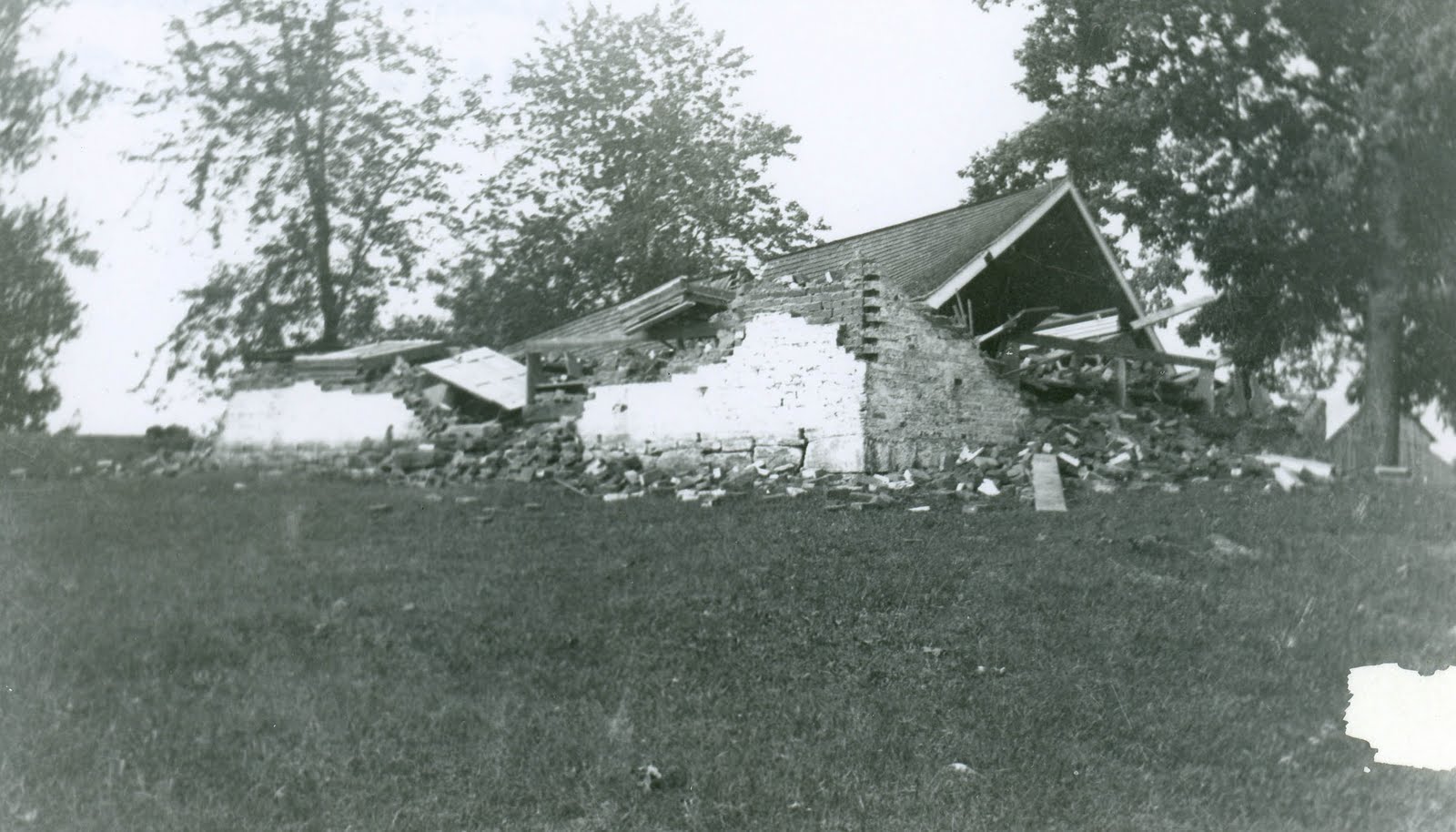
Dunker Church after a heavy storm in 1921
The church site was developed into a lunch room known as “Poffenberger’s Lunch Room.”
.
Eventually Boyer sold the original bricks and other building material to the National Park Service in 1951. A restoration project was finally completed in 1962 through a cooperative effort between the National Park Service, the Washington County Historical Society, the State of Maryland, and the Church of the Brethren. (3)
.
While the church was restored, its surroundings remained in private hands. The final photo in this series shows the Dunkard Church in 1971.

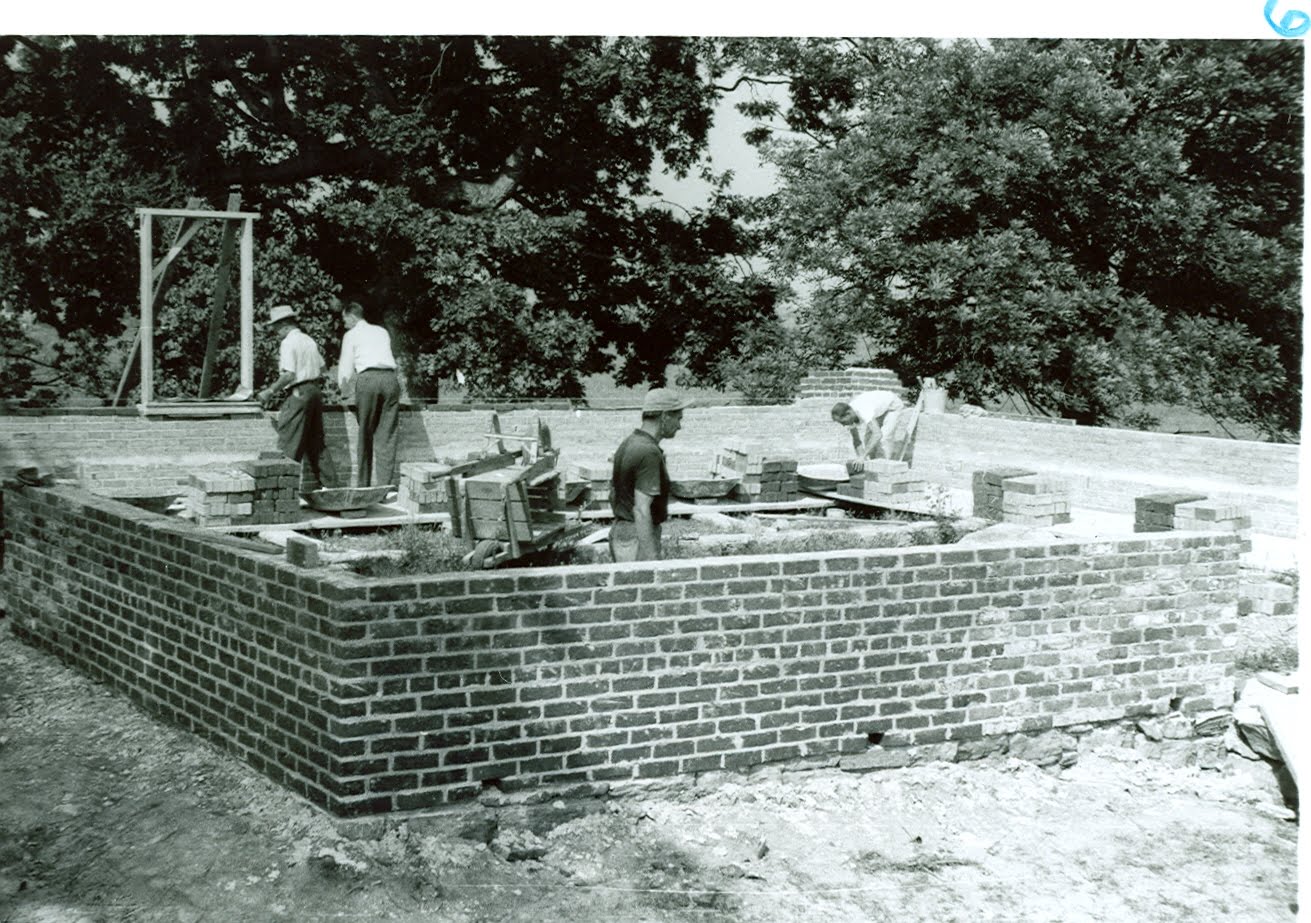
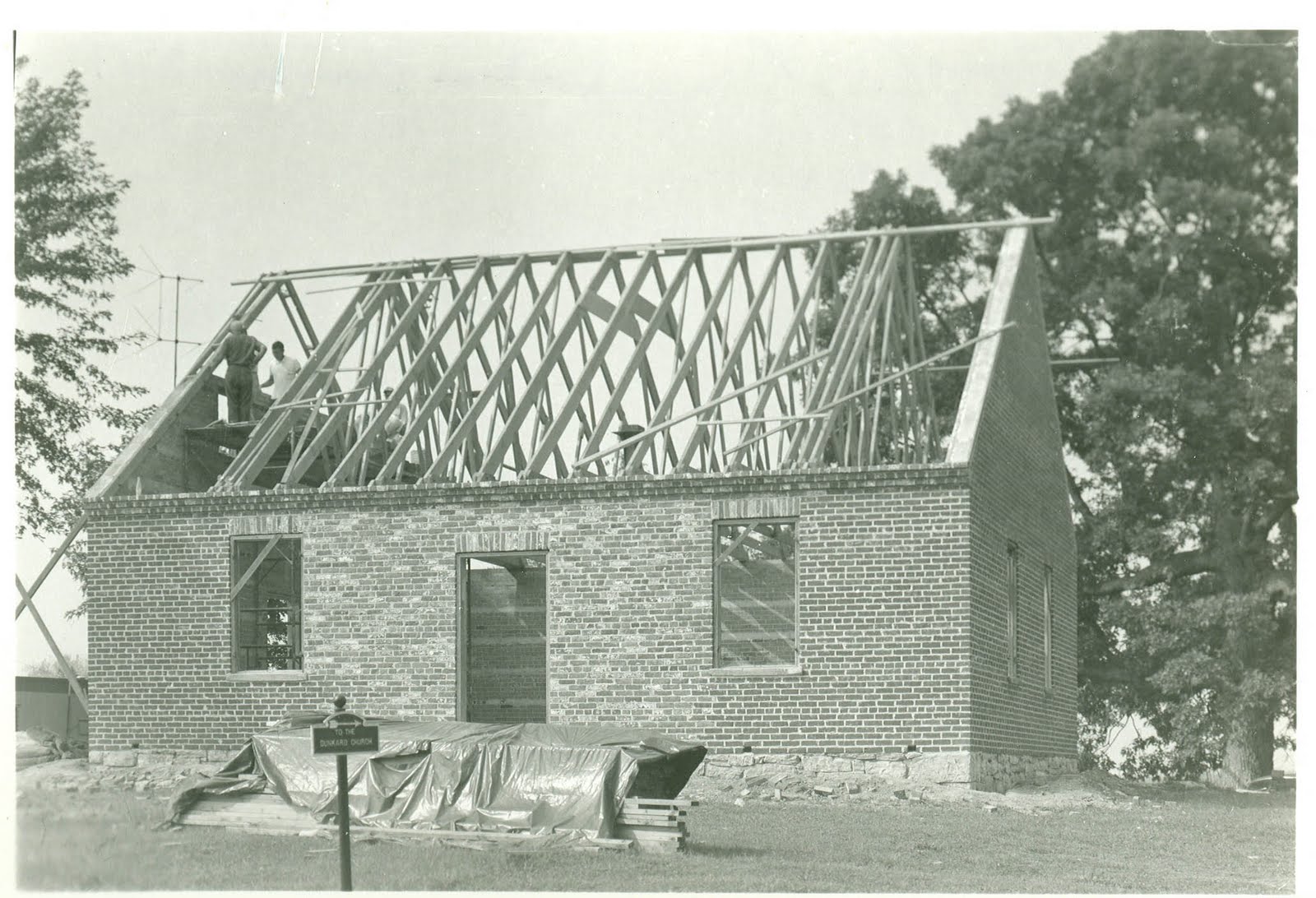

Dunker Church after reconstruction – 1971
1) Albert L. Magilton, “Report of theAntietam Battlefield Memorial Commission of Pennsylvania Ceremonies: Dedication of the Monuments Erected by the Commonwealth of Pennsylvania Mark the Position Of Four Regiments Of The Pennsylvania Reserves Engaged In the Battle. (Harrisburg, Pa.: Harrisburg Publishing Company, State Printer, 1908). Retrieved from: http://www.archive.org/stream/secondbrigadeofp00penn/secondbrigadeofp00penn_djvu.txt
2) “The Angle” Gettysburg Civil War Roundtable Newsletter, May/June 2009, page 3.
3) Freeman Ankrum, from Sidelights on Brethren History, (Elgin, IL: The Brethren Press, 1962), pp. 99-108. Retrieved from http://www.rockhay.org/peace/dunkerchurch/index.htm
(4) Elmer G. Boyer ran a grocery in Sharpsburg, Maryland. He resided at 142 Chapline Street with his wife and two children. (US Census, 1930).
Photos from Antietam National Battlefield Archives and Library. Courtesy NPS Ranger Alann Schmidt.
Artillery at Antietam

David R. Maher – 2011
If you plan on visiting Antietam National Battlefield in the future, make sure you swing by the Visitor Center bookstore and pick yourself up the latest brochure created by the staff at Antietam. It’s called “Artillery at Antietam”, and will set you back about $1.
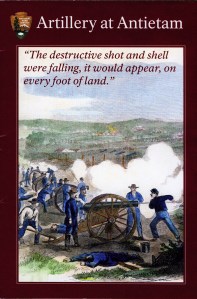
Inside you will find wonderfull facts, quotes, and images to help you learn about Civil War artillery, and why Antietam became forever known as “Artillery Hell.” Also inside, you will find a fantastic map noting the positions of all of the cannon now placed on the Battlefield, as well as information about each artillery battery those gun positions represent, and a great ‘range map’ which helps you understand the range and effectivness of artillery during the Battle.
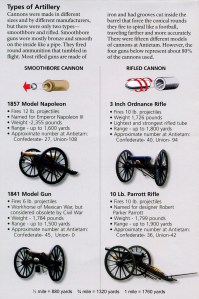
inside the brochure
For the first time, the guns of Antietam have become more than decorations on the landscape. Thanks to this brochure, and the recent historical repositioning of many of the guns, artillery at Antietam has become a powerful interpretive tool. So, during your next visit, pick up the brochure, and look for those guns!
Second Division, First Corps, Army of the Potomac

- Brig. Gen. James Ricketts
the west to command a division in the Army of the Tennessee on June 10, 1862. James Ricketts (USMA 1839) moved up from brigade command to succeed Ord in command of the division. Ord and Rickets were classmates at West Point ranking 15th and 16th respectively in the Class of 1839. Ricketts, an old regular, commanded Battery I, 1st U.S. Artillery at First Bull Run where he was severely wounded and captured. Released in December he was promoted to brigadier general U.S.V. effective back to July 21, 1861. He held brigade command for only three weeks before moving up to division command.
The division initially had four brigades. Two were new brigades of troops recently joined to the Washington defenses. Command of the first of the new brigades was given to Abram Duryee a militia officer from New York State. Duryee had significant pre-war militia training and had organized the 5thNew York Zouaves at the beginning of the war.
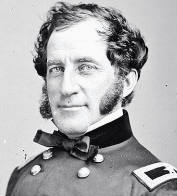
Brig. Gen. Abram Duryee
Previously commanding a brigade of garrison troops, Duryee received command of what became the 1st Brigade on April 16, 1862. James Ricketts (USMA 1839) assumed command of the other brigade of new troops that had also come out of the Washington defenses. George Hartsuff commanded the third brigade. The core of this brigade was originally Abercrombie’s brigade. It had been part of Nathanial Bank’s division and operated in the Shenandoah Valley. After Abercrombie was reassigned to a brigade in the Third Corps on the Peninsula, George Hartsuff, assumed command shortly before the brigade was assigned to the division. Its regiments were some of the first 3-year regiments raised in the summer of 1861 but they had not yet seen serious combat. The fourth brigade of the division would no longer a part of the Second division by the time of the Maryland Campaign. Prior to assignment to the 2nd Division, it was a part of James Shield’s division for much of the spring of 1862. Commanded by Colonel Samuel S. Carroll (USMA 1856), all but one regiment were transferred to the Washington defenses just prior to the Maryland campaign. That regiment, the 7th Indiana was reassigned to Hofmann’s brigade in the 1st Division of the corps.
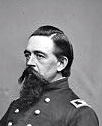
Col. William Christian
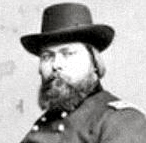
Brig. Gen. George Hartsuff
 Welcome to the official site for the Antietam Battlefield Guide Association. The Antietam Guides are a group of historians dedicated to providing outstanding interpretive tours of the Antietam Battlefield, as well as other sites related to the Maryland Campaign of 1862. The Antietam Guides are booked through the Antietam National Battlefield Museum Store. This site offers a listing of our battlefield guides, as well as updates about our programs, what our guides are up to, and information about Antietam National Battlefield. We hope to see you at the park soon!
 Antietam Battlefield Guides