Finding Antietam: A Guide’s Story, Laura Marfut
This is the twentieth essay in our monthly series “Finding Antietam – A Guide’s Story.” Each month, we’ll feature the story of one of our guides and what sparked their interest in Antietam and the Civil War and why they became an Antietam Battlefield Guide. Antietam Battlefield Guide Laura Marfut shares her story this month.
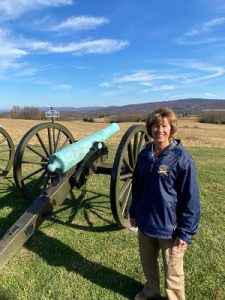 My introduction to Antietam began as a young girl living in nearby Hagerstown, when our family would pile in the car for family trips to the battlefield. My father, a WWII Navy veteran, was probably more interested in history than he thought his young daughters would want to hear, so instead we climbed the observation tower and played around the Dunker Church and Burnside Bridge. Years later, with a dose of high school history and hikes through the battlefield with my Explorer Post Scouting friends, I started to feel a tug that there was something special about Antietam. My friends felt it too, which led us on a late-night mission into the Sunken Road to detect whatever historical presence we thought we’d detect, though our nervous chatter over expecting to be expelled by a park ranger at any moment turned the event into something less somber than planned.
With college, ROTC and Army assignments, years passed without visiting Antietam, but I felt that tug again while stationed at Fort Hood, Texas in the 80’s. A friend loaned me a copy of William Frassinito’s book, Antietam: A Photographic Legacy of America’s Bloodiest Day, which compared photographs taken while the dead still lay where they fell, to the same fields I had traipsed with my family and friends. While growing up, I remembered articles in the Hagerstown newspaper about the community’s fierce resistance to development around the battlefield. As a result, Antietam is one of the most well-preserved and restored battlefields you’ll find. That’s something I hadn’t realized before, but the images in Frassanito’s book nearly took my breath away. You don’t have to use your imagination to see the battlefield through the eyes of those who fought there in 1862. Continue reading →
Finding Antietam: A Guide’s Story, Jim Smith
This is the nineteenth essay in our monthly series “Finding Antietam – A Guide’s Story.” Each month, we’ll feature the story of one of our guides and what sparked their interest in Antietam and the Civil War and why they became an Antietam Battlefield Guide. Antietam Battlefield Guide Jim Smith shares his story this month.
 Social media did a good thing for me a few years back when I came across a post seeking new Battlefield Ambassador volunteers at Antietam. One of my three principal pursuits of happiness (Rush shows) had dropped the curtain in 2015. It was time to find a new one. Or double down on a passion that had animated me since childhood: Civil War battlefields. Since I was very young, well before I fully comprehended their carnage, battlefields have resonated with me as places where something important happened, intersections with history. My appreciation of the meaning of our hallowed ground has only grown. I had come to Antietam a number of times over the years, including a visit in the (19)70s, when you couldn’t go north of the Bloody Lane, and another glorious day twenty years later that combined battlefield tramping with a ballgame in Frederick. Antietam was one of those major battlefields I was proud to have “checked off” my list as a student of the Civil War.
But here was an opportunity to get to a new level, to learn and engage with visitors at one of America’s most important historic sites, a place that every American who is able should see at least once. After training—from Antietam rangers and guides laden and generous with information—and accumulating some new resources on the battle, I ventured out on the field with my fellow volunteers, posted at stops along the driving tour. A pristine jewel of the National Park Service, Antietam offers not only its pastoral beauty, but also a sweeping and multi-faceted history—military, political, diplomatic, social, memory. I’d long enjoyed listening to interpreters at historic sites. Being on the other side of that equation has been even more uplifting and inspiring. Public history begets a virtuous circle: visitors ask questions; interpreters answer questions or go in search of answers, which usually leads to more questions. The rich history of the Maryland Campaign of 1862 provides an endless warren of pathways and connections, a countless number of avenues to explore, reaching backward and forward in time. It is a central event of the central event of American history, but in addition to the momentous aspects, there are the individual stories, humbling tales of the extreme human experience that was Civil War combat. Volunteering at Antietam, and later becoming a guide, has been a never-ending challenge to up my game. That challenge will never expire.
Driving past the NPS sign, on my way to give a tour, it’s the proverbial “pinch myself” moment every time. Though perhaps somewhat quiet and reserved in most other settings, I often end my day at Antietam with a raspy voice. It is a singular privilege and honor to try to illuminate a bit of history for those who come to the battlefield. Over the years, more than one skeptic has asked me why study these long ago campaigns. Because Antietam is part of our identity; it tells us something about who we are, just like a family remembrance or photo album does for each of us as individuals. And the stories of all who were here—their service and sacrifice—deserve to be remembered. The Civil War remains relevant. That will not change anytime soon.
Finding Antietam: A Guide’s Story, Chris Vincent
This is the eighteenth essay in our monthly series “Finding Antietam – A Guide’s Story.” Each month, we’ll feature the story of one of our guides and what sparked their interest in Antietam and the Civil War and why they became an Antietam Battlefield Guide. Antietam Battlefield Guide Chris Vincent shares his story this month.

Chris Vincent
My interest in the American Civil War and the Battle of Antietam, in particular, occurred many years ago when I was told the story of my great-great-grandfather, Henry Vincent. In August of 1862, Henry, who was from Montour County, Pennsylvania answered President Abraham Lincoln’s call for 300,000 nine-month militia. Henry enlisted in the ‘Danville Fencibles’ which was comprised of men mostly from the Danville Iron Works. Before the end of the month, they were mustered into service as Company A, 132nd Pennsylvania Volunteer Infantry Regiment, and in defensive works outside Washington. Like many Union soldiers at Antietam, this would be Henry’s first time in combat. The 132nd Pennsylvania was one fortunate enough to be brigaded with veteran soldiers as they attempted to take the Sunken Road. They took heavy casualties, but Henry made it through his ‘baptism of fire’ unscathed. According to the county history, “his coat sleeve was completely shot off at Antietam.” Henry would continue to serve with the 132nd and participate in the battles of Fredericksburg and Chancellorsville. He was promoted to Corporal in March 1863 and was mustered out with Company A on May 24, 1863. Henry returned home to Danville, to become a successful businessman, lawyer, and a father to eight children. He was an active member in both the 132nd Pennsylvania Volunteer Regimental Association and the Goodrich Post No. 22, of the Grand Army of the Republic until he passed away in 1916. Continue reading →
 Welcome to the official site for the Antietam Battlefield Guide Association. The Antietam Guides are a group of historians dedicated to providing outstanding interpretive tours of the Antietam Battlefield, as well as other sites related to the Maryland Campaign of 1862. The Antietam Guides are booked through the Antietam National Battlefield Museum Store. This site offers a listing of our battlefield guides, as well as updates about our programs, what our guides are up to, and information about Antietam National Battlefield. We hope to see you at the park soon!
 Antietam Battlefield Guides