Finding Antietam: A Guide’s Story, Gary Rohrer
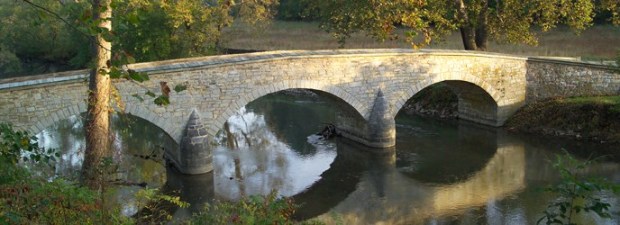
This is the first essay in our monthly series “Finding Antietam – A Guide’s Story.” Each month, we’ll feature the story of one of our guides about what sparked their interest in Antietam and the Civil War and why they became an Antietam Battlefield Guide. Antietam Battlefield Guide Gary Rohrer began his love of the battlefield and the Maryland Campaign as a young boy growing up in Washington County and spending many summer/fall days on South Mountain.

My grandfather owned the Mountain House (he called the South Mountain Tavern) from 1925 to about 1960 and some of my aunts and uncles lived and worked there with him. My family had little interest in the Civil War other than there had been a general killed in a battle and there was a monument in his memory on South Mountain. Later, I saturated myself with as much as I could learn from local historians and, combined with my own knowledge of the terrain, I put it all together.
I remember the reconstruction and dedication of the Dunker Church, the Clara Barton Monument, and finding the Texas monument on Cornfield Avenue when I came home from college on Christmas break. I also remember driving over the Burnside Bridge when the monuments stood on the bridge’s corners just before it closed to vehicular traffic.
As a young Boy Scout, I had enthusiastically participated in the Centennial Celebration lasting from August 31 to September 17, 1962. It would be the last reenactment to take place on the battlefield. Last spring, I was going through a box of boyhood trinkets in the attic and found the concessions badge that I was required to wear while passing out Official Programs at the Dunker Church and later found an original copy of that program through a dealer in Gettysburg.
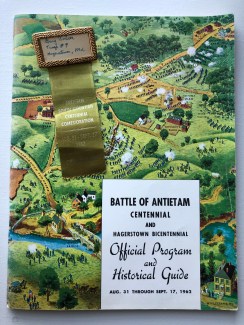
Gary’s 1962 Badge and a 1962 Centennial Program
I believe that my interest in the Maryland Campaign of 1862 was ignited by my Boy Scout experiences. The Mason-Dixon Council had Camporees and I vividly remember camping in the area of the Final Attack, sitting around the bonfires with several hundred Boy Scouts and listening to E. Russell Hicks, a local historian, tell of the fight for the Burnside Bridge and Final Attack. We had another one at Crampton’s Gap. Back then, the area below the arch wasn’t as wooded and it made for a natural amphitheater in Whipp’s Ravine. Mr. Hicks told the Saturday night bonfire story of the Sixth Corps’ attack on the Confederates and painted an image so vivid, I was looking around for Jennings’ guns “Sallie Craig and Jennie” firing down the roads at the oncoming Federals. By then, I was hooked.
My passion for the Civil War and local history grew over the years and I got deeply involved with genealogy and learned that my paternal great-grandfather was a 5-year veteran of the Civil War. He was in the Potomac Home Brigade or Railroad Brigade, was captured at Harpers Ferry in 1862 and paroled. He fought on Culp’s Hill at Gettysburg and I’m fortunate to have his original discharge papers.
When I decided to retire in 2009, it was former Superintendent John Howard who suggested I consider becoming a guide. I began as a volunteer Battlefield Ambassador and studied every book in my library on Antietam and the Maryland Campaign for a year and with the aid of numerous mentors, I became an Antietam Battlefield Guide in 2011. I am so honored to be a part of this magnificent group.
Historic Images of Antietam and Its Centennial Anniversary
Antietam Battlefield Guide Gary Rohrer recently found some of these historic images of Antietam in the Western Maryland Room at the Washington County Free Library. We post them here for all of you to see, as well as Gary’s memories of the Centennial Anniversary of the Battle of Antietam in 1962:
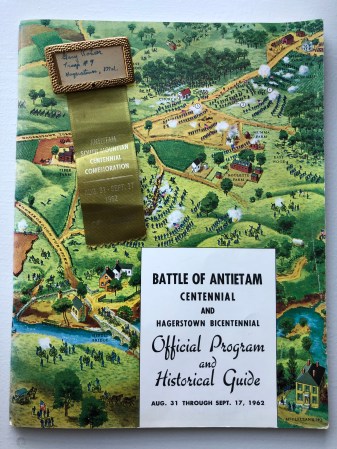
Gary’s 1962 Badge and a 1962 Centennial Program
“I’ve told the tired old stories of my Boy Scout days at Antietam National Battlefield and my enthusiastic participation at the Centennial Celebration lasting from Aug 31 to Sept 17, 1962. It would be the last reenactment to take place on the battlefield. Not long ago, I was going through some boyhood trinkets that I found in a box and much to my surprise was the concessions badge (left) that I was required to wear while passing out Official Programs in front of the Dunker Church. Last year, I was able to track down an original copy of the program from a dealer in Gettysburg (left).
I remember the reconstruction and dedication of the Dunker Church, the Clara Barton Monument, and finding the Texas monument on Cornfield Avenue when I came home on Christmas break from my first year in college. I remember driving over Burnside bridge just before it closed to vehicular traffic and the countless times in my youth that we drove over the bridge with the monuments on the corners. Of course, I’ve mentioned many times about my Boy Scout experiences camping in the area of the Final Attack and hearing great stories by E. Russell Hicks while sitting around the bonfires with several hundred Boy Scouts. That, along with a similar experience at Crampton’s Gap (needless to say) ignited my interest in the 1862 Maryland Campaign.”

This photo is after 1920 because we see the NY State Monument in the background.
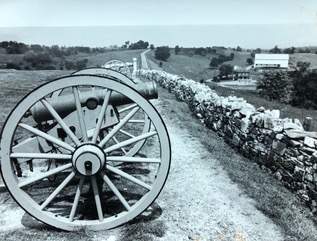
Branch Ave – Note the Sherrick Barn in the background and the dry laid stone fence in the foreground
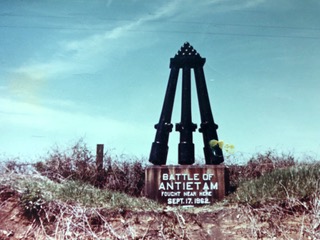
The Norfolk & Western Railroad monument along Shepherdstown Pike, west of the Antietam Train Station

Napoleons located on either side of Cornfield Ave

The Sunken Rd before the relocation of Richardson Ave. Note the concrete fence posts.
Congratulations to the newest Antietam Battlefield Guide
Jim Smith recently became the newest member of the Antietam Battlefield Guides. Please join us in offering our congratulations!
Find out more about Jim here, and don’t forget to book a tour with him. 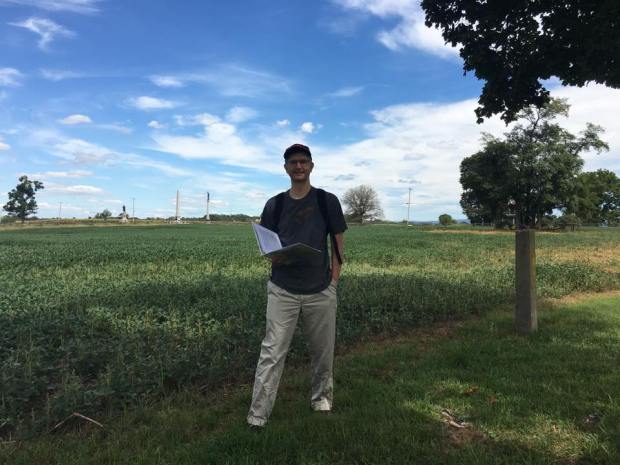
 Welcome to the official site for the Antietam Battlefield Guide Association. The Antietam Guides are a group of historians dedicated to providing outstanding interpretive tours of the Antietam Battlefield, as well as other sites related to the Maryland Campaign of 1862. The Antietam Guides are booked through the Antietam National Battlefield Museum Store. This site offers a listing of our battlefield guides, as well as updates about our programs, what our guides are up to, and information about Antietam National Battlefield. We hope to see you at the park soon!
 Antietam Battlefield Guides