Medals of Honor at Antietam: Harrisburg’s Soldiers’ Grove
the following post first appeared on the blog of Antietam Battlefield Guide candidate Dave Maher (Pennsylvania’s Emergency Men) on Sep. 17, 2011.

Soldiers’ Grove
September 17, 1862 will forever be known as the bloodiest day in American History. With roughly 23,110 Americans killed, wounded, or missing in the approximate twelve hours of fighting at the Battle of Antietam, the amount of truly sad and tragic stories are astounding. Weaved throughout the tragic battle narrative, however, are stories of bravery and courage, just as astounding. After the Battle, a total of twenty Medals of Honor were awarded for heroic actions taken during the fighting at Antietam.
For a history of the Medal of Honor click here.
 |
|
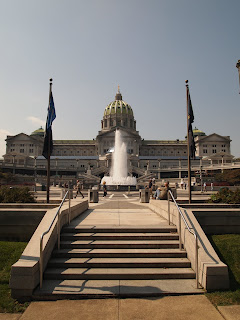
view of PA State Capital building from Soldiers’ Grove |
Earlier in the week, with the coming anniversary of the Battle Antietam, I decided to take a stroll over to the Medal of Honor Memorial in Soldiers’ Grove, located in the Capitol Complex, Harrisburg, PA and look for the names of the six Pennsylvania soldiers who earned their Medals that bloody day.
Dedicated in 1994, “the Medal of Honor Memorial commemorates not just one person or one war, but several hundred individuals who acted heroically in many wars, campaigns, and conflicts. Thirteen radiating arcs, representing the conflicts in which Pennsylvanians received the Medal of Honor, symbolize the tides of war.
 |
|
Medal of Honor Memorial |
Granite stones imbedded in the arcs identify the Medal recipients with the date and location of their deeds. On a scale of two feet equaling one year, the width of the arcs and the intervening grassy areas indicates the duration of each conflict and the periods of peace which followed them. At the center of each arc, random accounts of actual heroic deeds are inscribed on granite tablets and at the ends small diamond shaped insets give the name and date of each conflict. Thus a walk across the memorial becomes a narrative experience which places the individual hero in the sweep of history. At the far end of the memorial lie the shores of peace and the grove of remembrance. The design affirms the passage of time, the evolving present and our lasting tribute to these remarkable lives.”
Pennsylvania’s Antietam Medals of Honor

Hillary Beyer, 2nd Lieutenant, 90th Pennsylvania, Co. H [Christian’s Brigade, Rickett’s Division, Hooker’s Corps]
Entered Service at: Philadelphia, Pennsylvania
Citation: After his command had been forced to fall back [from the Cornfield, through the East Woods], remained alone on the line of battle, caring for his wounded comrades and carrying one of them to a place of safety.
Ignatz Gresser, Corporal, 128th Pennsylvania, Co. D [Crawford’s Brigade, Williams’ Division, Mansfield’s Corps]
Entered Service at: Lehigh County, Pennsylvania
Citation: While exposed to the fire of the enemy, carried from the field a wounded comrade.
Samuel Johnson, Private, 9th Pennsylvania Reserves (38th PA), Co. G [Anderson’s Brigade, Meade’s Division, Hooker’s Corps]
Entered Service at: Connellsville, Pennsylvania
Citation: Individual bravery and daring in capturing from the enemy 2 colors [flags] of the 1st Texas Rangers (C.S.A.), receiving in the act a severe wound.

Jacob G. Orth, Corporal, 28th Pennsylvania, Co. D [Tyndale’s Brigade, Greene’s Division, Mansfield’s Corps]
Birth place: Philadelphia, Pennsylvania
Citation: Capture of flag of 7th South Carolina Infantry (C.S.A.) in hand-to-hand encounter, although he was wounded in the shoulder.
William H. Paul, Private, 90th Pennsylvania, Co. E [Christian’s Brigade, Rickett’s Division, Hooker’s Corps]
Birth place: Philadelphia, Pennsylvania
Citation: Under a most withering and concentrated fire, voluntarily picked up the colors of his regiment, when the bearer and two of the color guard had been killed, and bore them aloft throughout the entire battle.

Charles B. Tanner, Second Lieutenant, 1st Delaware, Co. H [Weber’s Brigade, French’s Division, Sumner’s Corps]
Birth place: Philadelphia, Pennsylvania
Citation: Carried off the regimental colors, which had fallen within 20 yards of the enemy’s lines, the color guard of 9 men having all been killed or wounded; was himself 3 times wounded.
Tanner’s own account of the dangerous situation that day:
While covering that short distance, it seemed as if a million bees were singing in the air. The shouts and yells from either side sounded like menaces and threats. But I had reached the goal, had caught up the staff which was already splintered by shot, and the colors pierced with many a hole, and stained here and there with the lifeblood of our comrades when a bullet shattered my arm. Luckily my legs were still serviceable, and, seizing the precious bunting with my left hand, I made the best eighty yard time on record, receiving two more wounds
Tanner would later serve in the 69th Pennsylvania. For more on Tanner, click here

Poem written for the Memorial by State Poet, Samuel Hazo
150 years ago: the Battle of South Mountain
In honor of the Anniversary of the Battle of South Mountain, 150 years ago today, the following posts first appeared on the blog of Antietam Battlefield Guide candidate Tim Ware (Bloody Prelude: The Battle of South Mountain) on Sep. 1, 2012, and Sep. 11, 2012.
Men of the Phillip’s Legion
Listed here are a few photographs of men that would find themselves fighting for
their lives during the savage afternoon fighting that would swirl around the
Daniel Wise Cabin at Fox’s Gap.

Captain Hamilton, 1864
Captain Joseph E. Hamilton, Co. E: Born in April 1839, Captain Hamilton was only 23 when he lead his company into the maelstrom that was the afternoon fighting at Fox’s Gap. Commanding his company during the three regiment assault order by brigade commander Thomas F. Drayton, Hamilton would lead his company into the teeth of the massive Union 9th Corps. Under heavy musketry, the Hamilton would pull his men out of the fight but only after he was wounded and fortunately, he would be able to make his escape off the mountain. Hamilton would continue fighting until he was captured during the retreat to Appomattox. He would survive being sent to a northern prison and would live until 1907.
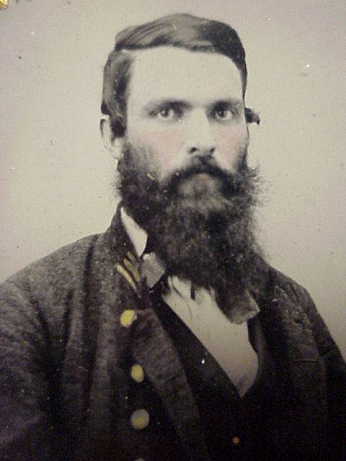
Capt. Johnson, circa 1863
Captain James M. Johnson, Co. L: A native North Carolinian, Captain Johnson would spend much of his life living in Georgia where he would attend the Georgia Military Institute. He would serve in the 14th Georgia Infantry before returning to Georgia after being discharge for disability in December 1861. Not wanting to miss out on the war, he enlisted in what would become Company L, Phillips’ Legion and was given command of the company as it’s captain. Leading his company at South Mountain, Hamilton would be wounded in the thigh and the nature of his wound would cause him to fall into the hands of Union forces. He would be paroled and returned to Richmond by October 1862. He would survive the fighting at Fredericksburg, Chancellorsville, and Gettysburg but would fall, mortally wounded, during the attack on Fort Saunders near Knoxville, Tennessee in late 1863.
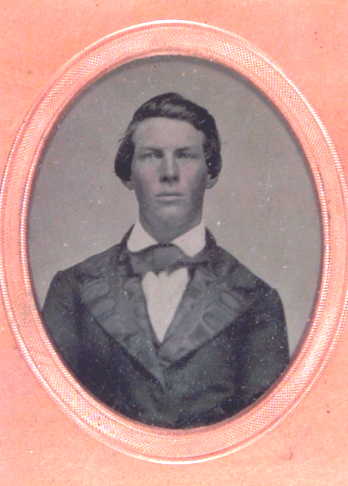
Lt. Jones, 1850s
1st Lieutenant Abraham Jones, Company D: Initially serving as part of a Georgia State Brigade, Lieutenant Jones would find himself serving in Phillips’ Legion in August 1861. Jones would serve with the regiment in the western Virginia campaign in late 1861 before the legion was sent back to the deep south to protect coastal areas. By July 1862, Jones was back in Virginia with the Legion as part of the newly created brigade of Thomas Drayton. During the ensuing campaign and victory at Second Manassas, Jones would write home that he believed the army was about to cross the Potomac. With his belief a reality,
Jones would march on the roads of western Maryland eventually reaching Hagerstown on September 11. On September 14, Jones would find himself marching back towards South Mountain. Arriving on the mountain, Jones would find himself at Fox’s Gap advancing through farmer Daniel Wise’s South Field and into a woodlot. Suddenly firing breaks out and after a severe firefight, Phillips’ Legion is forced from the field. Tragically, Jones would not be among the survivors. At some point during the fight, he would fall and he would be listed as killed as a result of the fighting. He would be buried with his fellow soldiers in mass graves in the fields around Fox’s Gap. Here he would rest until
the mid-1870’s when the Confederate dead were recovered, if possible, and
re-interred in Hagerstown, Maryland. If his grave was found, he is likely listed
as an unknown among the over 2,000 Confederates buried in Hagerstown.

Chaplain George Gilman Smith
Chaplain George Gilman Smith: Serving as the pastor of a small church in Georgia prior to the war, Chaplain Smith would find himself serving with the
Phillips Legion when war broke out. He would, to his disdain, receive the moniker “fighting chaplain”. Smith would find himself with the Legion’s battle
line as it advanced into Wise’s South Field at Fox’s Gap. With the advance and
confusion of the coming fight, Smith served as a sort of courier for the Legion
to help avoid a friendly fire situation and also to warn General Drayton of a
Union column advancing up the Old Sharpsburg Road. After warning Drayton, Smith saw that the Confederates were under fire from three directions. Rushing to warn the commander of the Legion, he saw them retreating in utter confusion. At this point, Smith would be severely wounded in the throat with a bullet entering his throat and exiting near his spine, paralyzing an arm. Smith would be carried off the field by a group of soldiers who believe his wound was mortal. Smith would survive his wounds and live until 1913. He wrote an account of his experience on the mountain that can be read here.
Remembering New Jersey’s Fallen

New Jersey, Adjutant-General’s Office. RECORD OF OFFICERS AND MEN OF NEW JERSEY IN THE CIVIL WAR, 1861-1865.[Trenton, NJ, John L. Murphy, Steam Book and Job Printer, 1876.] Two volumes. “Published by authority of the Legislature.” William S. Stryker, Adjutant General. (found online at the New Jersey State Library)
Second Division, First Corps, Army of the Potomac

- Brig. Gen. James Ricketts
the west to command a division in the Army of the Tennessee on June 10, 1862. James Ricketts (USMA 1839) moved up from brigade command to succeed Ord in command of the division. Ord and Rickets were classmates at West Point ranking 15th and 16th respectively in the Class of 1839. Ricketts, an old regular, commanded Battery I, 1st U.S. Artillery at First Bull Run where he was severely wounded and captured. Released in December he was promoted to brigadier general U.S.V. effective back to July 21, 1861. He held brigade command for only three weeks before moving up to division command.
The division initially had four brigades. Two were new brigades of troops recently joined to the Washington defenses. Command of the first of the new brigades was given to Abram Duryee a militia officer from New York State. Duryee had significant pre-war militia training and had organized the 5thNew York Zouaves at the beginning of the war.
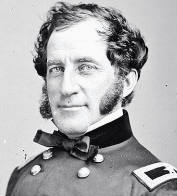
Brig. Gen. Abram Duryee
Previously commanding a brigade of garrison troops, Duryee received command of what became the 1st Brigade on April 16, 1862. James Ricketts (USMA 1839) assumed command of the other brigade of new troops that had also come out of the Washington defenses. George Hartsuff commanded the third brigade. The core of this brigade was originally Abercrombie’s brigade. It had been part of Nathanial Bank’s division and operated in the Shenandoah Valley. After Abercrombie was reassigned to a brigade in the Third Corps on the Peninsula, George Hartsuff, assumed command shortly before the brigade was assigned to the division. Its regiments were some of the first 3-year regiments raised in the summer of 1861 but they had not yet seen serious combat. The fourth brigade of the division would no longer a part of the Second division by the time of the Maryland Campaign. Prior to assignment to the 2nd Division, it was a part of James Shield’s division for much of the spring of 1862. Commanded by Colonel Samuel S. Carroll (USMA 1856), all but one regiment were transferred to the Washington defenses just prior to the Maryland campaign. That regiment, the 7th Indiana was reassigned to Hofmann’s brigade in the 1st Division of the corps.
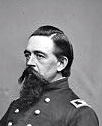
Col. William Christian
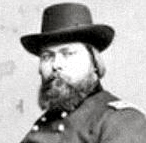
Brig. Gen. George Hartsuff
 Welcome to the official site for the Antietam Battlefield Guide Association. The Antietam Guides are a group of historians dedicated to providing outstanding interpretive tours of the Antietam Battlefield, as well as other sites related to the Maryland Campaign of 1862. The Antietam Guides are booked through the Antietam National Battlefield Museum Store. This site offers a listing of our battlefield guides, as well as updates about our programs, what our guides are up to, and information about Antietam National Battlefield. We hope to see you at the park soon!
 Antietam Battlefield Guides