March 16, 2013: Clemens/Frye lectures, book signing, and dinner
The Shepherdstown Battlefield Preservation Association Inc., and the Save Historic Antietam Foundation Inc. (SHAF) are co-sponsoring a book signing dinner on Saturday, March 16 at the War Memorial Building in Shepherdstown, WV. The dinner will celebrate the publication of Dr. Tom Clemens’s second volume of Ezra Carmen’s The Maryland Campaign of September 1862 and the publication of Dennis Frye’s book: September Suspense: Lincoln’s Union in Peril. Tom is the president of SHAF and Professor Emeritus of Hagerstown Community College. Dennis is Chief Historian at Harpers Ferry National Historical Park.

War Memorial Building – Historic Shepherdstown Commission
The book signing will be from 6:00 – 7:00PM during a cocktail hour. Dinner will be served afterwards. After dinner, Tom and Dennis will discuss the subject of their books. In addition, an auction of Civil War related items will be held at the dinner. The cost is $45 per plate. More details and reservations can be made at: http://www.battleofshepherdstown.org/Dinner2013.html
If you would like to donate a Civil War related item to the auction, please let us know. We hope to see you all on March 16.
Was McClellan’s Cavalry Deployment at Antietam Doctrinally Sound?
The following post first appeared on the blog of Antietam Battlefield Guide Jim Rosebrock (South From the North Woods) on Nov. 18, 2012.
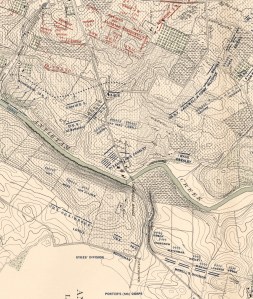
Middle Bridge, 3pm
This year, Savas Beatie published Volume II of Ezra Carmen’s monumental manuscript under the outstanding editorial pen of Tom Clemens. Tom’s work combines the manuscript of Carmen with the Copes maps for the best primary source account of this decisive battle. The most exceptional aspect of this book is Tom’s brilliant footnotes and references. He goes beyond merely citing a reference and includes a full degree of careful analysis. Here is an example.
Much is made (generally negative) of McClellan’s concentration of his cavalry, behind the center of his line.
In Landscape Turned Red, Stephen Sears has this to say: Shortly before noon, McClellan had ventured to push several batteries across the Middle Bridge, supported by Pleasonton’s cavalry and a force of regulars from George Syke’s Fifth Corps. He was nervous about the move-it was taken against the advice of Porter and Sykes-and he cautioned Pleasonton not to risk the batteries unduly. As an afterthought, he asked, “Can you do any good by a cavalry charge?” Pleasonton wisely ignored the suggestion.[1]
There is also a quotation in Carmen’s manuscript that criticizes the concentration of the cavalry in the center: “Another, a gallant young cavalry officer later in the war, says: ‘It is one of the surprising features of this surprising battle that the Federal cavalry, instead of being posted, according to the practice of the centuries, on the flanks of the infantry, was used throughout the day in support of its horse batteries, in rear of he Federal center, and in a position from which it could have been impossible for it to have been uses ad cavalry, or even to have emerged mounted.’”[2]
In Tom Clemen’s footnote to this quotation, we learn that the “gallant young cavalry officer” is George B. Davis. But Tom goes beyond identifying the author of this quote to take on the issue of the doctrinal soundness of Pleasonton’s cavalry position. Here is the complete cite: George B. Davis, The Antietam Campaign, in Campaigns in Virginia, Maryland and Pennsylvania 1862-1863, vol. 3, Papers of the Military Historical Association of Massachusetts (Boston, MA: Griffith-Stillings Press, 1903), p. 55. Davis had worked on publishing the Official Records and was the chair of the Antietam Battlefield Board, Susan Trail, Remembering Antietam, unpublished doctoral dissertation, Antietam National Battlefield Library. Davis’ opinion though worthy of respect, may be challenged by the strategic manual used as a textbook at the U.S. Military Academy in the antebellum era. Baron De Jomini, Summary on the Art of War, or a New Analytical Compend of the Principal Combinations of Strategy, Grand Strategy and Military Policy (New York, NY: G.P. Putnam & Co., 1854, pp 305-309, discussed cavalry placement and use in various situations, including a charge upon broken infantry lines with artillery support making success possible, and cited examples to demonstrate it. McClellan’s placement was consistent with Jomini’s principals.” (My bold)[3]
Tom makes a very important point here. Jomini was studied at West Point and his book states that this is a legitimate use of cavalry. McClellan’s employment was just as doctrinally sound in the constructs of the time as Lee’s was. Lee follows the more generally known employment of cavalry placing Fitzhugh Lee’s brigade and Pelham’s artillery are on the left flank, Thomas Munford’s brigade on the right, and Wade Hamptons brigade in reserve in the center. But as Jomini makes plain, that is by no means the only possible course of action. Sadly, many don’t reach this point.
The conventional interpreters ignore or are unaware of this fact. Sears says that Pleasonton “wisely ignored” McClellan’s suggestion. George Davis sets in stone the idea that cavalry is only employed on the flanks on the battlefield “according to the practice of the centuries”.
Some will argue that his failure to place the cavalry on the flanks prevented him from detecting the advance of A.P. Hill’s division. The reality is that the Union signal station on Red Hill had the Federal left flank of the battlefield under constant observation and detected the advance of Hill’s division. Some will proclaim McClellan’s failure to place cavalry on the flanks as an oversight or a mistake. McClellan is acknowledged, even by his most virulent detractors to be to careful and methodical planner to have overlooked the flanks. His move is a conscious decision to concentrate in the center.
I would go so far to venture this possibility. McClellan has poised his cavalry for an offensive move. The Middle Bridge corridor and Boonsboro Pike is the shortest and fastest route to the Potomac River. It is a risky venture and one that goes against the grain of the typical McClellan portrayal as a conservative commander. Consider that this is the first time that McClellan has concentrated his cavalry into one combat command. It is still a relatively weak vessel compared to the mighty legions of JEB Stuart’s cavalry division. Alfred Pleasonton, a decidedly mixed bag in terms of competence, commands the division. But the move is in the right direction. Not only is the cavalry division concentrated but it has also advanced across the Antietam and is poised further offensive action. The use or potential use of cavalry as an offensive weapon is a first in the annals of the Army of the Potomac. My point today is only to assert the legitimacy and doctrinal soundness of the employment. McClellan’s actual use of the cavalry later that afternoon is another matter that can be discussed at another time.
For those who would say that the placement of mobile forces in the center for a decisive attack there is doctrinally unwise and never works need only ask the French Army in 1940. That was their assumption until Guderian’s XIX Panzer Corps crossed the Meuse at Sedan and broke the French center.
So lets take off the table the idea that McClellan’s concept for deploying the cavalry was NOT doctrinally sound.
[1] Sears, Stephen, Landscape Turned Red The Battle of Antietam, New York: Ticknor and Fields, 1983. page 271.
[2] Carmen, Ezra. The Maryland Campaign of 1862 Volume II Antietam, edited by Tom Clemens, El Dorado CA: Savas-Beatie, 2012, page 364.
[3] Ibid
“Our brigade made itself gloriously conspicuous…” – Pvt. George Nickels, 89th NY
The following post first appeared on the blog of Antietam Battlefield Guide Dave Maher (Pennsylvania’s Emergency Men) on Dec. 2, 2012.
Sometimes being known around the office as “the Civil War guy” has its perks. Recently, a colleague came to me with a copy of a letter written on September 30, 1862 by Pvt. George Nickels of the 89th New York. During the Maryland Campaign, the 89th New York was, along with the 9th and 103rd New York Regts., a part of Col. Harrison Fairchild’s 9th Corps brigade. At the Battle of Antietam, Fairchild’s brigade would suffer the highest casualty percentage of any Union brigade; nearly 50%. Of the 368 men in the 89th New York, 103 were killed, wounded, or missing.
Nickels’ letter not only offers us colorful descriptions of Burnside’s push toward Sharpsburg late in the afternoon on September 17th, but also information on the condition of the troops, observations of the countryside in western Maryland, and invaluable information on a comrade who would later be buried in Antietam National Cemetery; Charles Courtney.
As you might imagine, I was pretty excited to read and transcribe the letter, especially since it probably has not been shared anywhere before. I took the opportunity to annotate many of the names that Nickels mentions also.
Antietam, Md. Sep, 30 1862
Dear Friends:
I have written one hasty letter since our fight, and you will have probably read a full description of the great battle of Antietam and the brilliant dash of Burnsides troops. Our brigade made itself gloriously conspicuous and the rebels were scattered before it like sheep, but we were then flanked by a heavy force on our left and were cut down by artillery on the right and front, and to save ourselves from complete destruction we had to fall back, and we did it without running too, and the rebels did not dare to follow us. We had caused many of them to bite the dust and many, also, of our brave boys were laid low. I don’t know but Almon[i] and Byron[ii] will get home before you see this, and they will give you the incidents of our march. Almon, I got a chance to see but I was not able to see Byron, and I can’t find out where they are now, but I think they have got furloughs. I am very sorry to lose them, it is lonesome in camp with them gone. I am sorry too for Byron’s great misfortune. Our first Lieut[iii] and, C Courtney[iv], who had legs amputated, have since died. Since the battle we have had a little easier times, but having left our knapsacks with our things at Washington we are getting pretty dirty and ragged. We cannot get papers to write on so you must excuse us and tell friends to excuse us till we can get our pay, or things which we expect soon. I got Moses[v] letter of the 10th last Sunday and want you all to write after. I also got a letter from Sarah F. I should write to Charles now if I had paper. Orville J. Oliver[vi] has a bad looking flesh wound in the thigh but is now in camp with the rest of the boys, he will, probably, get a furlough for 30 days. Capt Brown[vii] has resigned and been honorably discharged from the service. He is going home in a few days. James[viii] is now doing the duty of Orderly and is kept quite busy. He stands a good chance of promotion to first seargent [sp]. This is a fine country and there is the most corn, and the best I ever saw. The farms are large and well cultivated. The farmers owning from 500 to 1000 acres, and plow large portions of it for corn and wheat. But wherever we stop the corn, apples poultry are cleaned for miles, and we burn up all the fences. The government will have to pay the damage. It makes the country look desolate. I don’t know whether the enemy will give us a chance to fight him again or not And I don’t care. We have heard no firing for a number of days. They say the pickets are only a few miles from us. But they will have to retire before long. We will soon be after them If they don’t. Well I can’t think of anything more to write so Good bye
Yours Ever Geo. L. Nickels[ix]
[i] REED, ALMON L.—Age, 22 years. Enlisted at Whitneys Point, to serve three years, and mustered in as private, Co. F, October 22, 1861; transferred to Veteran Reserve Corps, no date. From Annual Report of the Adjutant-General of the State of New York for the Year 1901: Registers of the 88th, 89th, 90th, 91st, 92nd, & 93rd Regiments of Infantry.
[ii] Unable to locate name in roster of 89th New York in Annual Report of the Adjutant-General of the State of New York for the Year 1901: Registers of the 88th, 89th, 90th, 91st, 92nd, & 93rd Regiments of Infantry.
[iii] VAN INGEN, GARRETT.—Age, 30 years. Enrolled at Elmira, to serve three years, and mustered in as sergeant-major, December 5, 1861; as first lieutenant, Co. F, May 21, 1862; wounded in action, September 17,1862, at Antietam, Md.; died of his wounds, September 26,1862, at Sharpsburg, Md. Commissioned first lieutenant, October 17, 1862, with rank from May 20, 1862, vice Moses Pieffer [or Puffer] resigned. From Annual Report of the Adjutant-General of the State of New York for the Year 1901: Registers of the 88th, 89th, 90th, 91st, 92nd, & 93rd Regiments of Infantry.
[iv] COURTNEY, CHARLES I.—Age, 20 years. Enlisted, September 9, 1861, at Whitneys Point, to serve three years; mustered in as private, Co. F, October 1, 1861; wounded in action, September 17, 1862, at Antietam, Md.; died of his wounds, September 29, 1862, at Sharpsburg, Md. From Annual Report of the Adjutant-General of the State of New York for the Year 1901: Registers of the 88th, 89th, 90th, 91st, 92nd, & 93rd Regiments of Infantry. Courtney is buried in Antietam National Cemetery.
[v] Possibly PUFFER [or PIEFFER], MOSES.—Age, 36 years. Enrolled, September 9, 1861, at Whitneys Point, to serve three years; mustered in as first lieutenant, Co. F, October 1, 1861; discharged, May 20, 1862. Commissioned first lieutenant, December 18,1861, with rank from October 1,1861, original. From Annual Report of the Adjutant-General of the State of New York for the Year 1901: Registers of the 88th, 89th, 90th, 91st, 92nd, & 93rd Regiments of Infantry.
[vi] OLIVER, ORVILLE P.—Age, 21 years. Enlisted, September 9, 1861, at Whitney’s Point, to serve three years; mustered in as private, Co. F, October 4, 1861; re-enlisted as a veteran, January 11, 1861; transferred to Co. G, Nineteenth Regiment, Veteran Reserve Corps, May 19, 1865; promoted corporal, August 1, 1865; discharged, September 12, 1865, at Buffalo, N. Y.; also borne as Orville T. and Orville T. From Annual Report of the Adjutant-General of the State of New York for the Year 1901: Registers of the 88th, 89th, 90th, 91st, 92nd, & 93rd Regiments of Infantry.
[vii] BROWN, ROBERT.—Age, 39 years. Enrolled, September 9, 1861, at Whitney’s Point, to serve three years; mustered in as captain, Co. F, October 25, 1861; discharged, September 28, 1862; again mustered in as captain, same company, November 28, 1862; discharged, October 19, 1861; prior service in Eighth Militia. Commissioned captain, December 18, 1861, with rank from October 1, 1861, original; recommissioned captain, November 7, 1862, with rank from same date, vice himself resigned. From Annual Report of the Adjutant-General of the State of New York for the Year 1901: Registers of the 88th, 89th, 90th, 91st, 92nd, & 93rd Regiments of Infantry.
[viii] NORTHRUP, JAMES E.—Age, 23 years. Enrolled, September 9, 1861, at Whitneys Point, to serve three years; mustered in as sergeant, Co. F, October 22, 1861; promoted first sergeant, no date; re-enlisted as a veteran, January 14, 1864; mustered in as second lieutenant, October 21, 1864; as first lieutenant, January 11, 1865; discharged, June 19, 1865, at Richmond,Va.; also borne as Northrop and Northrupt. Commissioned second lieutenant, September 16, 1864, with rank from July 13, 1864, vice G. H. Baldwin promoted; first lieutenant, January 27, 1865, with rank from January 11,1865, vice Baldwin mustered out. From Annual Report of the Adjutant-General of the State of New York for the Year 1901: Registers of the 88th, 89th, 90th, 91st, 92nd, & 93rd Regiments of Infantry.
[ix] NICHOLIS [NICKELS], GEORGE L.—Age, 23 years. Enlisted, October 22, 1861, at Lisle, to serve three years; mustered in as private, Co. F, October 23, 1861; discharged, May 28, 1863, at Washington, D. C; also borne as Nichols. From Annual Report of the Adjutant-General of the State of New York for the Year 1901: Registers of the 88th, 89th, 90th, 91st, 92nd, & 93rd Regiments of Infantry.
 Welcome to the official site for the Antietam Battlefield Guide Association. The Antietam Guides are a group of historians dedicated to providing outstanding interpretive tours of the Antietam Battlefield, as well as other sites related to the Maryland Campaign of 1862. The Antietam Guides are booked through the Antietam National Battlefield Museum Store. This site offers a listing of our battlefield guides, as well as updates about our programs, what our guides are up to, and information about Antietam National Battlefield. We hope to see you at the park soon!
 Antietam Battlefield Guides